27th October 2026
People, perspectives, places…and pinxtos: The 2026 European RCE Regional Meeting
Learning for Sustainability Scotland (LfSS) is Scotland’s United Nations University-recognised Regional Centre of Expertise in Education for Sustainable Development (RCE). Globally, there are now 200 Centres across 78 countries: grouped into four Regions – Africa and Middle East, Asia-Pacific, Americas, and Europe.
The RCEs located in the Europe Region recently held their annual Meeting; which comprised a hybrid gathering hosted by RCE Basque Country-Navarre. In this blog, our Chair, Professor Rehema White, shares her reflections on this inspiring and informative event.
Four members of LfSS have just returned from the 2026 RCE Europe Regional Meeting that was hosted by our colleagues at RCE Basque Country-Navarre.
Rather than a membership model such as the one employed by LfSS, RCE Basque Country-Navarre uses a formal partnership model; drawing together 66 partners in an alliance for lifelong, life-wide learning. Their Co-ordinator, Samuel Fernández Diekert, led us and other European RCEs on a journey from Bilbao around their region; visiting 14 of those partners in a whistle-stop tour of the potential for education to foster sustainability transformation; including opportunities for the sharing experiences from our own regions.
Day 0: Welcome and orientation
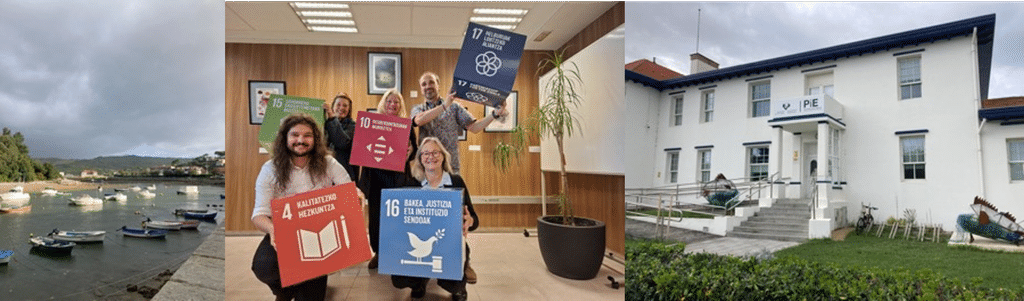
We registered with our hosts at UN Etxea – Basque Country Association for UNESCO and then moved to the Mondragon Team Academy (MTA) and met some of the staff and students in the Entrepreneurial Leadership and Innovation faculty (LEINN). These inspirational students are combining sustainability and entrepreneurship in teams running real-world projects.
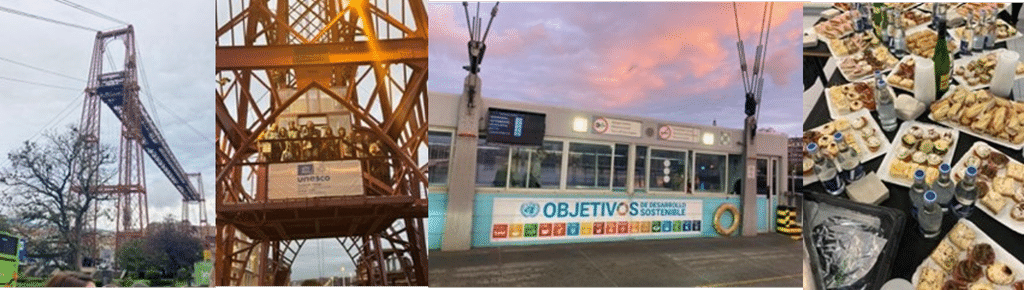
We then visited the oldest hanging bridge in Europe, Bizcaya Bridge (a UNESCO World Heritage Site) and Puerto Viejo Algorta, Getxo before concluding the evening with a reception at Trinitarias Ikastetxea. Here we were fed our first pinxtos of the trip. Cod, tuna, cheese or olives on bread slices are just some of the things that comprise the Basque Country’s answer to tapas!
Day 1: Empowering communities. Education as the Foundation of Regional Enabling Environments
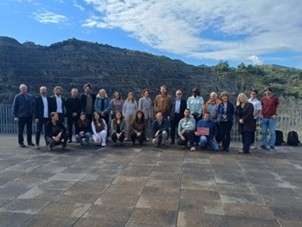
We boarded our conference bus expectantly and headed off to Ekoetxea Meatzaldea (IHOBE), Gallarta. This educational institute and conference venue is perched on the edge of a huge hole – the site of an old iron ore mine and indicative of the region’s recent industrial strength. We heard inputs from the Global RCE Service Centre at the UN University’s Institute for the Advanced Study of Sustainability (UNU-IAS) and UNESCO’s ESD for 2030 Global Network, with panels chaired by RCE Europe Regional Advisor, Betsy King, and shared presentations and experiences through talks and posters; including reflection on our activities in Scotland from our Development Manager, Cecilia Mañosa Nyblon, and Project Manager, Kirsten Leask.
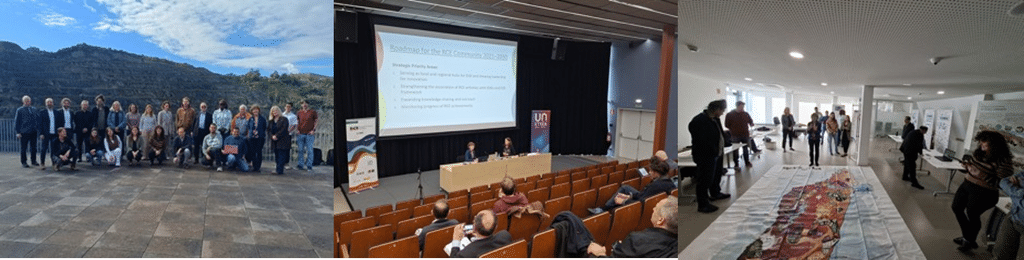
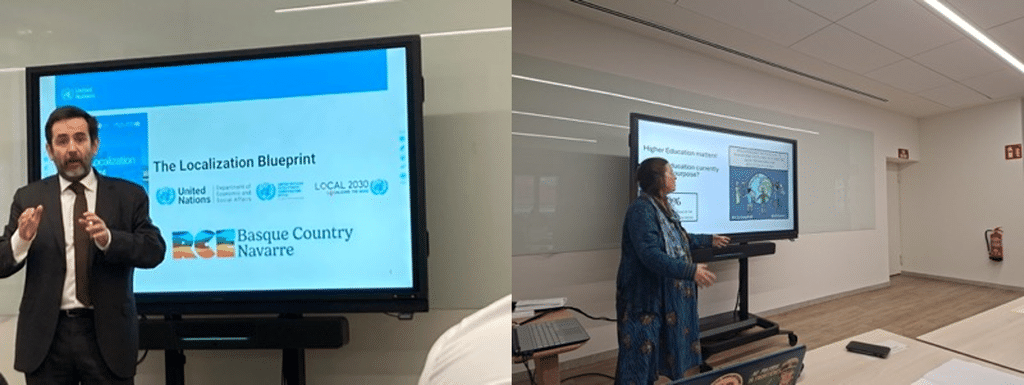
The afternoon session saw us back in Bilbao, visiting BBK Kuna, ‘The Home of the SDGs’ and UN Etxea. There we heard inspiring talks from Javier and Arantzazu, who spoke of the need to explore non-growth models and genuinely consider the risks of unsustainability. Javier called on us to ‘take care’; situating compassion as the core of humanity and the pursuit of human rights. He highlighted the epistemological challenge of moving beyond the current financial/political model to a new ethic of care.
There was talk of territory as place, where actors interact to perform the future. Their theory of change, represented by a growing tree, will enable them to 1) empower people and build conducive environments; 2) enhance capacities, innovation and collaboration; 3) co-create pathways for change; 4) localise finance and build systemic investment pipelines; and 5) amplify and follow up. Along with discussion of economic models, we explored the philosophy of Habermas, and the importance of culture, belonging and long-term policy and action. Rehema talked on critical perspectives and practices; drawing on our recent book on ESD in higher education. The evening venue, Elkartenet Hezkuntza Elkartea, showcased some of the wonderful work being done to enable effective action on sustainability, equity and fairness: showcasing the vision of a local NGO employing circular economy techniques to enhance digital access in underprivileged communities.
Day 2: Co-creating Regional Pathways. Mission-Oriented Roadmaps for Systematic Transformation.
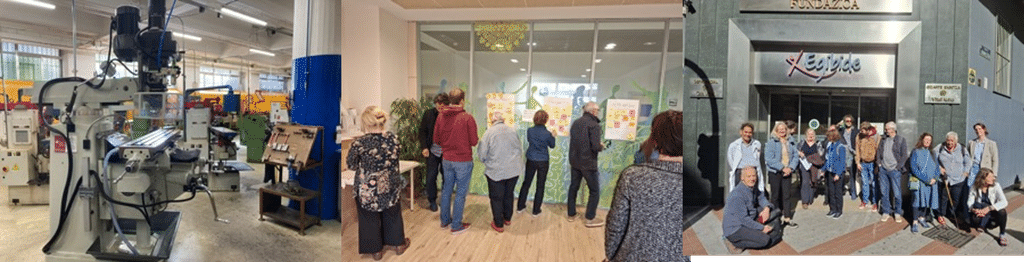
On Day 2, we travelled to Egibide, the TVET (vocational learning) centre in Vitoria-Gasteiz (Araba), the capital of the Basque country. There, in a hybrid session, we heard from young people and less young people about the projects they are working on. A workshop with colleagues from partners located in the French Basque Country helped us understand how people hold different understandings of the meanings of words and how we can tackle power asymmetry in collaborations. We were granted a tour of the technical and vocational college, which has excellent facilities for metalworking, cooking, robotic engineering and microbiology.
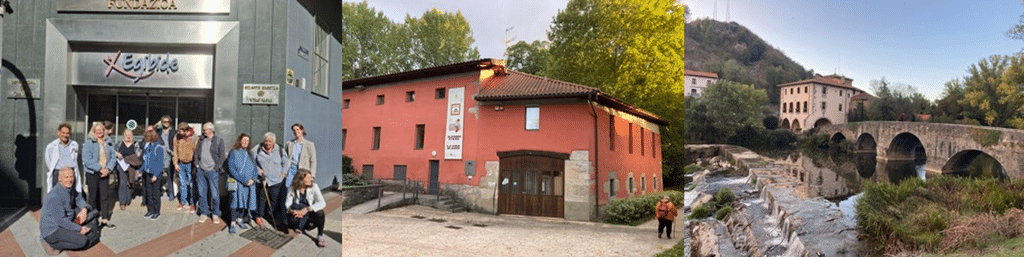
Back on the bus for a trip to Pamplona, Navarre. No bull running or ancient city walls for us – we headed straight to the hosting partner organisation in Molino de San Andrés, Mancoeduca, for discussions around service learning and a creative shared session for collaborative RCE action across Europe. A guided walk along the river led us from one mediaeval mill to another at Batán de Villava. Beavers had chewed riparian trees and we imagined other species coming down from the surrounding hills. This ancient pathway and bridge form part of the Camino de Santiago, and the feeling of people working and passing here for centuries was strengthened in the exhibition of sustainable textiles and old textile mill machinery.
Day 3: Building Capacities for Localization: Skills, Innovation, and Regional Knowledge for the SDGs
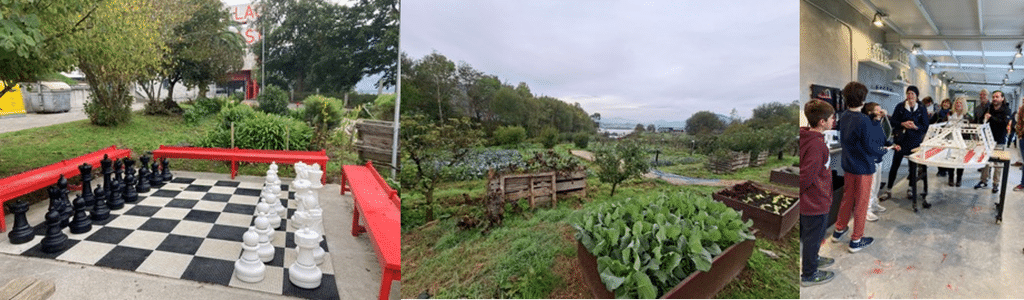
Our merry band once more climbed into the bus and headed to Lauaxeta Ikastola, Amorebieta on the way to Gipuzkoa. This impressive school has playing fields high amongst the hills, a school farm with vegetables and pet goats, opportunities to build electric cars in science class, sing Basque songs, play giant chess, and to join special cultural activities. There is a huge dining hall for healthy, social lunches, cooked from fresh ingredients grown on site.
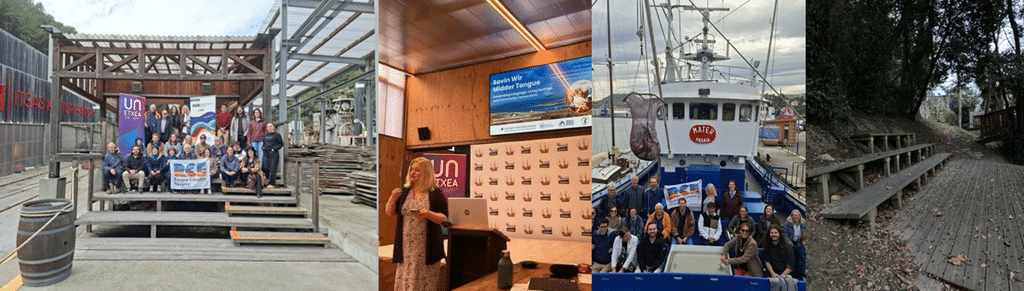
We left our 10 and 11-year-old guides reluctantly and headed on to Albaola Itsas Kultur Faktoria, Pasaia. This coastal village has witnessed the restoration of old sailing and tuna fishing ships. A fascinating session explained why RCE Basque Country-Navarre is promoting and advocating for another SDG: SDG 18 Cultural and Linguistic Diversity. There were clear and exciting synergies with aspects of Scottish culture, heritage and identity – and Kirsten shared more about the ‘Savin Wir Midder Tongue’ initiative currently being co-delivered by LfSS to sustain, promote, and celebrate Shaetlan language and heritage in Scotland.
After our daily pinxtos, we boarded MATER, the Ecoactive Museum Boat, where we saw how this floating classroom promotes sustainability around the coast. Back on the bus to Zumaiena Ikastola, Zumaia, where we visited another inspirational all-through school. A 1960s building had been tackled by architects and imaginative teachers to create fun, flexible, age-specific spaces and a magical forest with outdoor classrooms. Children and young people had even built their own geodesic dome learning space and we heard many stories of effective learning and teaching.
Day 4: Exploring opportunities – ‘The Atlantic Arc’
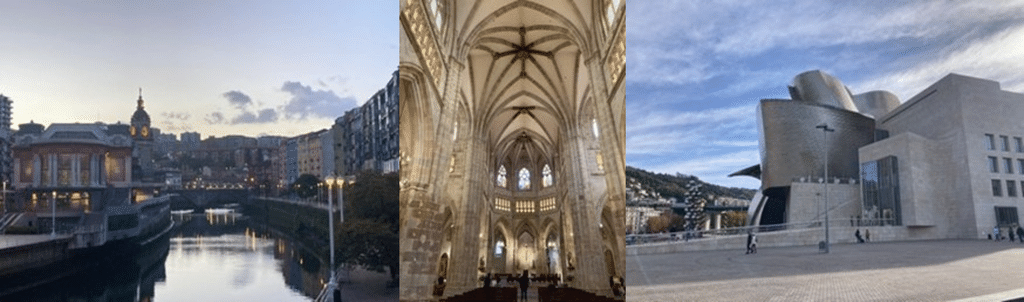
The main gathering concluded on Day 3, but a hardy few (including LfSS!) stayed for discussion of the proposed ‘RCE Atlantic Arc’ on Day 4 in Plentzia, at the end of the Bilbao regional subway line. We visited the PIE marine research centre and discussed new alliances for RCEs on the Atlantic coast connected by ocean water and a shared interest in our maritime history and futures. Before heading home, we had the chance to visit the Guggenheim Museum and see some of the inspiring installations. A fitting end to a wonderful few days full of collaboration, innovative ideas, sharing, and connection.